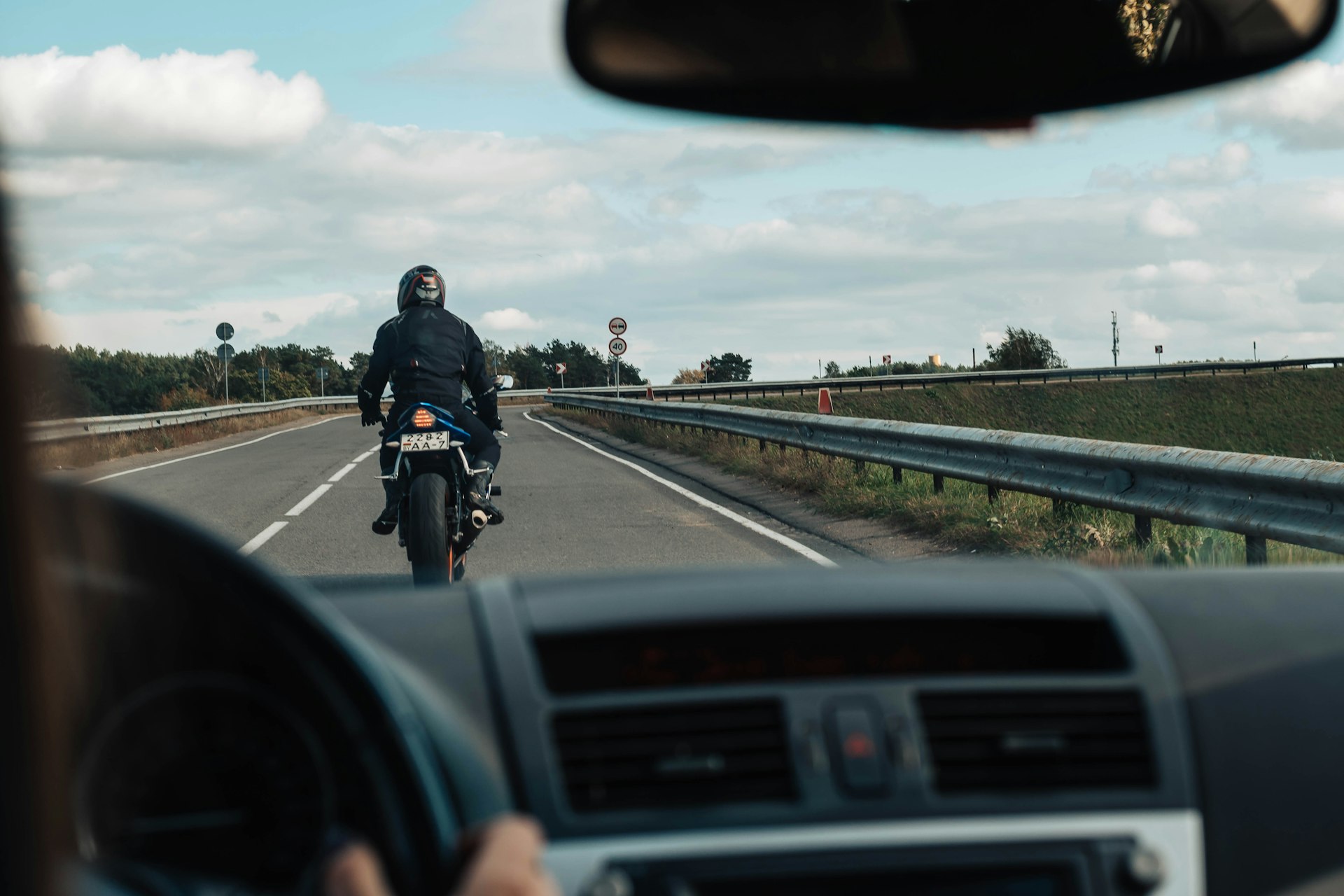
What Should We Do After a San Diego County Motorcycle Crash?
Free consultation with Ronald B. Laba. Call (760) 940-6231.
“The Law office of Ronald B. Laba have helped me navigate the justice system through providing detailed explanations of the journey of the lawsuit Ron is helping through. Ron has always communicating what’s going on with my lawsuit step by step with my case made me feel at easy through a very difficult time assuring me that everything will be fine not to lose faith. I appreciate Ron and his team for being there for me and my family I would highly recommend Ron’s law firm”
By Ronald B. Laba, California attorney (State Bar No. 115846) · Updated November 20, 2026
Reviewed by Ronald B. Laba, Attorney (Cal Bar 115846) on November 20, 2026
Short answer
We recommend putting medical care and safety first: call for emergency help, follow responders’ instructions, and avoid riding an unsafe motorcycle. If you can safely do so, collect driver and witness information and preserve photographs. Our next priority is reviewing reporting requirements and claim deadlines promptly, rather than waiting until treatment ends.
Key takeaways
- We recommend seeking medical evaluation promptly and preserving your helmet, riding gear, photographs, and original camera footage without altering them.
- We explain that drivers, unless rendered incapable, must exchange identifying, vehicle, and financial-responsibility information with other involved drivers or property owners present at the scene. Cal. Veh. Code § 16025.
- We flag the written injury-crash reporting requirement within 24 hours to the CHP or, for a crash within a city, the CHP or that city’s police department. Cal. Veh. Code § 20008.
- We also review the separate DMV reporting requirement: a driver involved in a covered injury crash generally must report it within 10 days, personally or through an authorized representative, subject to statutory exceptions. Cal. Veh. Code § 16000.
- We distinguish the generally applicable two-year personal injury lawsuit deadline from the public-entity claim deadline, which generally requires presenting an injury claim within six months after accrual. CCP 335.1; Gov. Code 911.2.
- We recommend immediate coverage review after a hit-and-run. Uninsured-motorist hit-and-run conditions include reporting to police within 24 hours and submitting a sworn statement to the insurer within 30 days; these steps alone do not establish coverage. Ins. Code 11580.2.
What do we recommend doing first when someone is hurt?
When a motorcycle crash leaves you hurt and worried about deadlines, we recommend separating the immediate emergency from the paperwork. Start with medical help. Call 911, describe the location as accurately as possible, and explain that a motorcycle rider is injured. Follow the dispatcher’s instructions rather than trying to assess a serious injury yourself.
We recommend avoiding unnecessary movement if you suspect a head, neck, or back injury, unless remaining where you are exposes you to immediate danger. Do not try to lift the motorcycle or collect scattered belongings while injured. Ask an uninjured person to speak with responders or help identify the crash location if you cannot do so safely.
California also imposes assistance duties on drivers involved in injury crashes. Under Veh. Code 20003, a driver must render reasonable assistance to an injured person, including arranging transportation for treatment when treatment is apparently necessary or the injured person requests transportation. We recommend explaining any immediate need for assistance clearly.
Put treatment ahead of documenting the scene
We suggest telling medical personnel what happened and describing your symptoms accurately, including symptoms that seem less important than your most painful injury. Explain whether you struck your head, lost consciousness, or have gaps in your memory. We recommend following the treating clinician’s instructions and asking whom to contact if symptoms change.
- Keep discharge instructions and appointment information together.
- Ask someone you trust to help save paperwork while you receive care.
- Write down symptoms and limitations when you are able, without guessing about a diagnosis.
- Do not delay recommended care to photograph the motorcycle or speak with an insurance adjuster.
We understand that reporting deadlines can feel urgent. Our practical recommendation is to ask for help handling those tasks while you focus on treatment. Once immediate medical needs are addressed, we can help organize the crash date, reporting status, available records, and questions requiring prompt attention.
What information do we recommend exchanging at the scene?
We recommend gathering identifying information calmly, without turning the exchange into a debate about who caused the crash. If your injuries prevent you from participating, tell the responding officer or someone helping you. Do not put yourself in traffic or postpone emergency treatment to obtain a photograph of a document.
Under Cal. Veh. Code § 16025, drivers involved in a crash must, unless rendered incapable, exchange specified information with another involved driver or property owner present at the scene. We recommend using this checklist:
- The driver’s name, current residence address, and driver’s license number.
- The vehicle identification number.
- The registered owner’s current residence address.
- Evidence of financial responsibility; when that evidence is insurance, the insurance company’s name and address and the policy number.
For a crash involving injury or death, Veh. Code 20003 also requires the driver to provide identifying information to the specified people involved and any traffic or police officer at the scene. That information includes the vehicle registration number, the owner’s name and current residence address, and the names and current residence addresses of injured occupants of the driver’s vehicle.
Keep information gathering separate from fault discussions
We suggest checking that photographs of documents are readable before leaving them as your only record. Also note the vehicle’s plate, make, model, and color when safe. If the driver and owner are different people, record that distinction rather than assuming they are the same.
We recommend asking witnesses for their names and contact information and whether they are willing to describe what they saw. Record their words accurately; do not suggest answers. If another driver refuses to cooperate or becomes confrontational, we recommend stepping back and telling responding law enforcement what information is missing. Record what you safely can, but do not pursue a departing vehicle or place yourself at risk to complete the checklist.
How do we recommend preserving motorcycle crash evidence safely?
We recommend preserving what is available without making evidence collection another source of injury. If you are receiving treatment, ask a trusted person to help. Photographs can wait when taking them would require entering traffic, approaching an unstable vehicle, or moving despite medical concerns.
When safe, we suggest taking both wide photographs showing the overall scene and closer photographs showing specific details. An isolated picture of motorcycle damage may not show where the vehicles were positioned or what surrounded them. Keep original files rather than saving only cropped, filtered, or annotated versions.
- Photograph the motorcycle and other involved vehicles from several angles.
- Capture visible damage, debris, road markings, signs, and relevant surface conditions from a safe location.
- Save available helmet-camera or other video files and make a separate backup.
- Preserve photographs of visible injuries without delaying treatment.
- Keep the helmet, protective clothing, and damaged equipment rather than discarding or altering them.
Make a factual record while details are fresh
We recommend writing a short account once you are medically able. Include the approximate time, direction of travel, what you saw before impact, and what happened afterward. Separate direct observations from assumptions. If you cannot remember something, record that uncertainty rather than filling the gap.
For example, if you remember a vehicle moving toward your lane but not whether its signal was operating, we recommend recording precisely that. Ask witnesses to preserve any recordings they already have, and note possible camera locations for follow-up rather than attempting to obtain footage through confrontation.
We also suggest recording where the motorcycle was taken and discussing documentation before repairs or disposal. Keep messages, photographs, report numbers, and medical instructions in one folder. Preserve original correspondence as well as your notes about telephone calls.
Our goal at this stage is a usable record, not a finished explanation of fault. We can review what has been collected, identify unanswered questions, and help prioritize follow-up. We do not recommend asking an injured rider to return to a hazardous scene simply because a photograph is missing.
Which police and DMV reporting deadlines do we flag?
We recommend treating law-enforcement reporting and DMV reporting as separate checklist items. A call for emergency help should not be your only follow-up. Record the responding agency, any incident number, and what written reporting has been completed so we can help identify remaining tasks.
The written law-enforcement report: 24 hours
For an ordinary motorcycle injury crash, Cal. Veh. Code § 20008 requires the driver to make or cause to be made a written report within 24 hours to the California Highway Patrol. If the crash occurred within a city, the report may instead be made to that city’s police department. We recommend promptly confirming the written-report status with the appropriate agency rather than assuming someone else has handled it.
The DMV report: 10 days
Under Cal. Veh. Code § 16000, a driver involved in a covered motor-vehicle crash causing bodily injury or death must report it to the DMV within 10 days. The statute permits reporting personally or through an insurance agent, broker, or legal representative and contains an exception for specified government vehicles. Because this section addresses an injured rider, we recommend checking the injury-based reporting requirement rather than waiting for a motorcycle repair estimate.
We suggest keeping a copy of each submission and any confirmation. If you are hospitalized or otherwise unable to manage paperwork, ask for assistance promptly and explain what has already been submitted.
A hit-and-run needs an additional deadline check
For a potential hit-and-run uninsured motorist claim, we also flag the police-report requirement within 24 hours and sworn statement to the insurer within 30 days under Ins. Code 11580.2. These are among the statute’s coverage conditions, not a promise that coverage applies.
If a deadline may already have passed, we recommend seeking advice immediately rather than assuming nothing can be done. Bring the crash date, policy documents, reporting confirmations, and correspondence so we can review the specific circumstances.
What should we review immediately after a hit-and-run?
We recommend getting medical help first, reporting the collision promptly, and preserving whatever identifying information you safely obtained. After a hit-and-run, we also recommend an immediate insurance review: California’s uninsured motorist statute includes reporting requirements measured in hours and days, not just the longer period associated with filing an injury lawsuit. See Ins. Code 11580.2.
We would first ask whether you remember a partial license plate, vehicle color, body style, direction of travel, or distinguishing damage. We recommend writing down those details without filling gaps with guesses. If someone witnessed the collision, preserve their contact information and any messages they sent. Do not pursue the departing vehicle or return to traffic to collect debris.
For a potential hit-and-run uninsured motorist claim, we flag the police-report requirement within 24 hours and the sworn-statement requirement to the insurer within 30 days under subdivision (b) of Ins. Code 11580.2. We would review the circumstances and policy before advising whether the claim satisfies the statute’s coverage conditions. Meeting these reporting deadlines alone does not establish coverage.
We separately flag the written injury-crash reporting requirement: a driver generally must make or cause a written report to the CHP, or to the appropriate city police department when the collision occurred within a city, within 24 hours. We explain that requirement under Cal. Veh. Code § 20008 rather than treating an insurance notification as a substitute.
We also recommend saving original camera files, photographs, damaged riding gear, and insurer correspondence. For example, if a witness sends a short video, keep the original message and file rather than only a screenshot. During our review, we examine the separate two-year requirement concerning suit, agreement, or an arbitration demand under subdivision (i) of Ins. Code 11580.2. We would not advise relying on routine claim correspondence to satisfy that requirement.
How do we distinguish lawsuit deadlines from public-entity claim deadlines?
We separate your deadline review into distinct tasks: crash reporting, insurance requirements, public-entity claim presentation, and filing a lawsuit. We do not treat these as one interchangeable deadline. When you are hurt and trying to arrange treatment, a dated checklist can make the next steps easier to manage.
For an injury action based on another person’s wrongful act or neglect, we start with the two-year limitation period in CCP 335.1. We then review the collision date and circumstances before identifying the filing deadline. We would not recommend waiting until treatment ends to begin that review.
If a public entity may be involved, we examine a different, earlier requirement. A claim relating to personal injury or personal-property injury must generally be presented within six months after the cause of action accrues under Gov. Code 911.2. We ask about government vehicles and any roadway condition you believe contributed to the crash—not because either fact establishes liability, but because it identifies an issue requiring prompt investigation.
We distinguish presenting that claim from filing a court action. For claims subject to presentation, suit against a public entity generally cannot proceed until a written claim has been presented and acted upon or deemed rejected. We explain that sequence under Cal. Gov. Code § 945.4.
We also review any rejection notice and its envelope. The applicable lawsuit period is generally six months after qualifying written rejection notice is personally delivered or mailed; without written notice, the statute provides two years from accrual. We assess those provisions under Gov. Code 945.6.
If six months may already have passed, we recommend immediate review rather than assuming every option is closed. A late-claim application may be presented within a reasonable time not exceeding one year after accrual under Gov. Code 911.4. We would evaluate eligibility and the remaining procedural steps individually.
What do we recommend doing before discussing fault or signing documents?
We recommend separating what you personally observed from conclusions about who caused the crash. Describe the vehicles, movements, impact, and symptoms as accurately as you can. If you do not remember a detail, say so. We discourage guessing about speed, distance, or timing simply because someone asks for an immediate answer.
We do not recommend withholding required identifying information. Unless rendered incapable, drivers must exchange identifying, vehicle, and financial-responsibility information with other drivers or property owners involved and present at the scene under Cal. Veh. Code § 16025. We distinguish that obligation from volunteering an unsupported explanation of fault.
We also explain the difference between compassion and a factual admission. California protects qualifying expressions of sympathy from use as admissions of liability in a civil action, but that protection does not extend to accompanying statements of fault. We discuss that distinction under Cal. Evid. Code § 1160. Our practical recommendation is to focus on getting assistance and describing facts rather than debating blame beside the roadway.
Before an insurance conversation, we suggest gathering your notes and asking what information the representative needs. Record the representative’s name, the claim number, and any requested response date. We recommend reviewing the policy and the particular request before deciding how to handle a recorded statement; we do not offer a blanket instruction to ignore your insurer.
Before signing a settlement document, release, or authorization, we recommend obtaining a complete copy and identifying exactly what it addresses. We would ask whether your medical evaluation is ongoing and whether the document concerns motorcycle damage, bodily injury, or both.
A general release ordinarily does not extend to claims you do not know or suspect exist when signing and that would materially have affected the settlement if known, under Cal. Civ. Code § 1542. We nevertheless recommend reviewing the actual language rather than assuming that provision resolves every concern. Bring all pages and attachments so we can discuss the document in context.
How can we help organize the next steps during a consultation?
At Law Offices of Ronald B. Laba, APC, we can help turn scattered paperwork and urgent questions into a practical next-step list. We begin with immediate reporting concerns, then review potential claim deadlines, available documents, and questions requiring further investigation. These are seven questions we encourage you to bring.
What should we bring if we have very little paperwork?
We suggest bringing the crash date, your contact information, any agency or insurance claim numbers, photographs, and messages. We can start by identifying what is available and what still needs to be requested.
Should we wait until medical treatment is finished?
We recommend discussing deadlines while treatment continues. We can organize the legal review around your medical appointments rather than asking you to postpone care or wait for a complete medical picture.
What if we could not collect evidence at the scene?
We recommend listing possible witnesses, camera locations you remember, and anyone who helped afterward. We can discuss practical follow-up without asking you to revisit an unsafe location or reconstruct details you cannot recall.
Do we need to discuss a DMV report?
Yes. We review the generally applicable 10-day DMV reporting requirement for crashes involving bodily injury under Cal. Veh. Code § 16000, including whether an exception applies. We ask what has already been submitted and recommend preserving confirmation.
What if an insurer has already contacted us?
We suggest saving the correspondence and noting any requested response date. We can review the request, the policy documents you have, and any statement or authorization you already provided.
How should we prepare our deadline questions?
We recommend a simple timeline showing the collision, reports, insurer contacts, and received notices. We then identify which dates need verification and which documents require prompt attention.
How can we arrange a consultation?
We invite you to call our office at (760) 940-6231 for a free consultation. Our attorney is Ronald B. Laba, California State Bar No. 115846. You pay nothing unless we win. Fee details are discussed in person during your free consultation.
We provide this article as general California legal information; our assessment of your next steps depends on the facts and documents we review.
Frequently asked questions
Do I need a complete set of medical records before contacting your office?
We do not recommend waiting until every record is available before contacting us. For an initial discussion, we can start with the crash date, a brief account of what happened, the treatment you have received, available insurance information, and any letters or forms already delivered to you. We recommend keeping discharge instructions, appointment details, and a dated record of symptoms and daily limitations, without guessing at a diagnosis. Deadlines can make an early review important: CCP 335.1 provides a two-year period for an injury action based on another’s wrongful act or neglect, while Gov. Code 911.2 generally requires presentation of a public-entity injury claim within six months after accrual. We can help identify the next documents to gather. Call our office at (760) 940-6231 for a free consultation.
What if I have only a partial license plate or an unclear photograph?
We recommend preserving whatever you have without trying to fill gaps through guesswork. Keep the original photograph or recording, write down the characters you actually remember, and distinguish uncertain details from confident observations. Other useful information may include vehicle color, distinctive damage, direction of travel, and witness contact information. Do not pursue the vehicle or put yourself in danger to obtain more details. If the driver cannot be identified, we would promptly review possible uninsured motorist coverage and the applicable reporting requirements. Ins. Code 11580.2 includes hit-and-run conditions involving a police report within 24 hours and a sworn statement to the insurer within 30 days. Those steps do not, by themselves, establish coverage. We would review the policy and circumstances rather than assume that an incomplete plate prevents further investigation.
Does the other driver’s promise to handle everything mean I can stop tracking paperwork?
We recommend continuing to track your own documents even if the other driver seems cooperative. Keep the driver’s messages, insurance information, and any claim number, but do not treat a verbal assurance as confirmation that reporting has been completed. Cal. Veh. Code § 16000 generally requires the driver to report an injury crash to the DMV within 10 days. Cal. Veh. Code § 20008 separately addresses a written injury-crash report within 24 hours. We would check each reporting task individually and retain copies of what was submitted. For a potential injury lawsuit, CCP 335.1 provides a two-year limitation period for injury caused by another’s wrongful act or neglect. Our practical recommendation is to have us review the applicable dates rather than organize your response around another driver’s promise.
Can a family member help with paperwork while I am receiving treatment?
We recommend asking a trusted family member to organize documents while you focus on medical care. That person can collect the crash date, vehicle information, insurance correspondence, photographs, and names of people who witnessed what happened. For the DMV report, Cal. Veh. Code § 16000 allows reporting personally or through an insurance agent, broker, or legal representative; an injury crash generally carries a 10-day reporting deadline. The written injury-crash reporting provision in Cal. Veh. Code § 20008 requires the driver to make or cause a report to be made within 24 hours. We would review who is handling each task rather than assume that a relative’s phone call completes it. Keep copies and confirmation of submission together, and tell our office promptly if treatment has prevented you from addressing either report.
What if I was a passenger rather than the motorcycle’s driver?
We would start by separating your role as an injured passenger from the duties assigned to drivers. The information-exchange requirements in Cal. Veh. Code § 16025 apply to drivers, unless rendered incapable, while Veh. Code 20003 requires an involved driver to provide identifying information and reasonable assistance after an injury crash. As a practical matter, we recommend that passengers preserve their own photographs, medical records, witness contacts, and recollection of events. Do not rely entirely on either driver to document your injuries or concerns. Tell us where you were seated, what you observed before impact, and whether you have received insurance correspondence. We can then review the circumstances without assuming that the motorcycle operator or another driver was responsible merely because of their role in the collision.
What should I do if I realize my first account of the crash was inaccurate?
We recommend writing down the correction promptly, along with why your understanding changed. Separate what you personally remember from information someone else supplied afterward. For example, you might initially confuse a vehicle’s color but later find a photograph that clarifies it. Preserve the original photograph and the earlier statement; do not edit records to make the discrepancy disappear. If the inaccurate information went to an officer or insurer, we can discuss how to provide a clear factual correction through the appropriate channel. Cal. Evid. Code § 1160 distinguishes expressions of sympathy from statements of fault: its protection for sympathy does not extend to an accompanying statement of fault. We therefore recommend accuracy rather than speculation, including saying that you do not remember a detail when that is true.
Should I keep my helmet and riding clothing even if they look ruined?
We recommend keeping the helmet, jacket, gloves, boots, and other riding equipment in their post-crash condition while we assess their relevance. Photograph each item, including visible damage and identifying labels, and note who has possession of it. Avoid cleaning, repairing, discarding, or altering these items before discussing preservation with our office. This is an evidence-preservation recommendation, not advice to reuse damaged safety equipment. We also recommend preserving original camera recordings and photographs rather than retaining only edited clips or screenshots. California law permits the fact finder to consider a party’s willful suppression of relevant evidence under Cal. Evid. Code § 413. We would therefore discuss preservation before anything is discarded and help you identify what may matter to understanding the collision and the injuries you describe.
Related questions
- California Personal Injury Statute of Limitations: Don't Miss Your Deadline
- Uninsured & Underinsured Motorist Claims in California
- When Should I Hire a Lawyer After a Car Accident in San Diego County?
Talk with our office
Call (760) 940-6231 or send us a message for a free consultation. Learn more on our practice page, browse our learning center.
Legal authorities
In This Article
Free Case Review
Get your case evaluated at no cost
Prefer to talk?
(760) 940-6231What Our Clients Say
Real testimonials from successful cases
"I wanted to take a moment to sincerely thank you for everything you did to..."
"The Law office of Ronald B. Laba have helped me navigate the justice system through..."